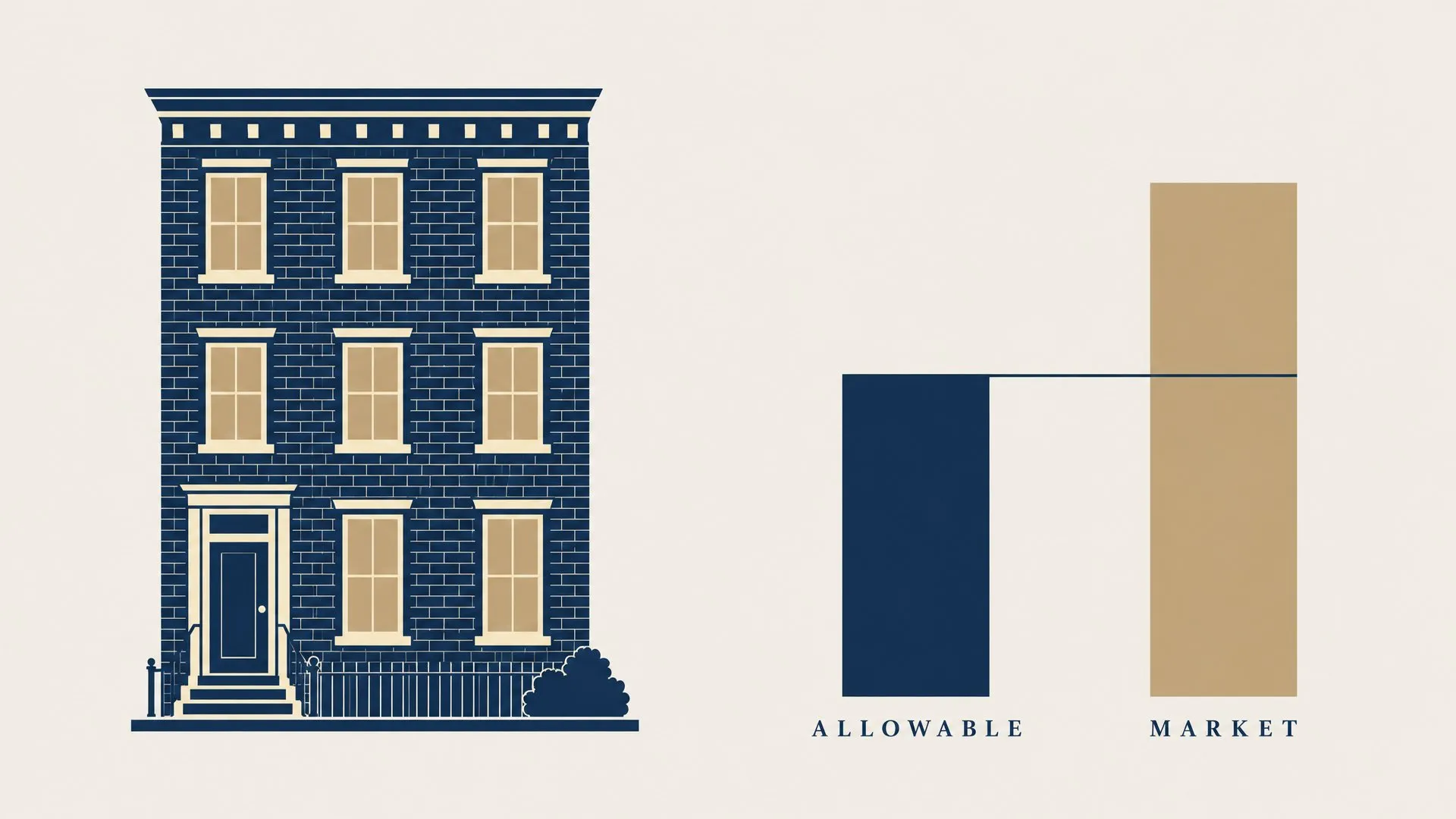

Sell, refinance, or hold. Owners treat that like a personality question. Are you a seller or a holder? Are you conservative or aggressive?
It is not a personality question. It is arithmetic, with three columns. In 30 years, I have almost never met an owner who had built the third one.
Here are all three columns, with the arithmetic shown.
You are comparing a price to a loan
Here is what usually passes for analysis. The owner gets a price opinion from a broker. Then he gets a refinance quote from a lender. He looks at both numbers and picks one.
Those two numbers are not comparable. One is a gross sale price, before commission, before closing costs, before the loan payoff, before taxes. The other is a loan, which is money you have to pay back.
Comparing them is like comparing your salary to your credit limit. Both are numbers. They mean completely different things.
And the third option, doing nothing dramatic and improving the building for two years, usually never gets a number at all.
Column one: sell
Start with your gross price. Then subtract, in order:
- Commission.
- Closing costs. Title, transfer and recordation taxes, and legal.
- Your loan payoff.
- Any prepayment penalty.
- Depreciation recapture, taxed at up to 25 percent on every dollar of depreciation you have taken.
- Capital gains on the appreciation.
- Net investment income tax, which lands on top for a lot of owners at these numbers.
What lands in your account is usually 20 to 30 percent below the headline price. Sometimes more.
That is column one. It is the only column most comparisons ever include, and usually only the top line of it. Your tax lines depend on your own basis and history, so get them from your CPA rather than from a rule of thumb.
Column two: refinance
Column two is cash-out proceeds. Here is the appealing part: that money is not taxed today. It is loan proceeds, not income.
It is constrained by two tests, and the tighter one sets your loan. Loan to value, typically 65 to 75 percent. And the debt service coverage test, which is usually the tighter one. DSCR: The Number That Decides Your Loan Size walks through how that test sizes the loan.
The trade has a cost. A new payment. A new term. And you still own the building, and every problem in it.
Refinance is the right answer when the building still has room to run and you want to keep running it.
Column three: hold and improve
What is the building worth in 24 months if you fix the NOI first? Take your current NOI, add what a cleanup recovers, and divide by the same cap rate. Then subtract the cost and the risk of doing that work.
That is a real number. It just requires you to do something.
An illustrative example:
- Current NOI: $313,000. At a 6 percent cap rate, $313,000 divided by 0.06 is about $5.22 million.
- A cleanup recovers $21,000 of NOI. $313,000 plus $21,000 is $334,000.
- At the same 6 percent cap rate, $334,000 divided by 0.06 is about $5.57 million.
- The difference is the recovered income capitalized: $21,000 divided by 0.06 is $350,000 of value.
- The cost of the work might be $15,000 and six months of your attention.
The cap rate did not move in that example. The income did. The market still sets the cap rate and the price. What you control is the NOI that goes into the arithmetic.
Here is the line that gets me disagreement. Owners who sell often should have refinanced, and owners who refinance often should have sold. The third column is the one that most often wins.
I am not telling you to hold. I am telling you that you cannot know until the column exists.
The three columns on one building
Here is the math on a $4 million building. The figures are illustrative.
Column one, sell.
- Gross price: $4,000,000
- Commission and closing, roughly: minus $240,000
- Loan payoff: minus $1,500,000
- Taxes, call it: minus $400,000
- Net: $4,000,000 minus $240,000 minus $1,500,000 minus $400,000 is about $1.86 million.
Column two, refinance.
- At a 1.25 coverage test, that same building supports about $2.72 million of new debt. That is 68 percent of $4 million, inside the 65 to 75 percent loan-to-value range, so coverage is the test that binds.
- Pay off the $1.5 million existing loan.
- Cash out: $2.72 million minus $1.5 million is roughly $1.2 million, tax free today, and you still own the building.
Column three, hold and improve. Recover NOI first, as in the example above, then run columns one and two again on the higher number. The cleanup changes both of them.
The side-by-side on whether a sale or a cash-out builds more wealth over time is in Cash-Out Refinance or Sell? Which Actually Builds Wealth. This article is about the column that comparison leaves out.
The tiebreaker nobody asks first
What are you actually going to do with the money?
If you do not have an answer to that, a sale is not a strategy. It is a taxable event with good lighting.
David: the cleanup changed the answer
David owns nine units. Before the cleanup, selling was clearly the right answer.
After the cleanup, $24,000 of recovered NOI added about $400,000 in value. The arithmetic: $24,000 divided by 0.06 is $400,000. That extra value also supported a bigger loan.
Same building. Same market. The cleanup changed which column won. He refinanced.
The work behind that kind of recovery is in How to Increase NOI on a Small Apartment Building.
Build your three columns
Take your building and fill in all three. Column one is what a sale nets after every line comes off. Column two is what a refinance takes out after the existing loan is paid. Column three is your NOI after a real cleanup, divided by the same cap rate, less the cost and risk of the work.
If you have never written down column three, that is the first job.
Own a building in Washington DC, Virginia, or Maryland? In DC, TOPA timing changes the sale column before any tax number does: Selling a DC Apartment Building
Leaning toward a sale? The Exit Navigator Scorecard puts the readiness questions on one page. Then book a free 15-minute call and we will build all three columns on your building together.
Leaning toward column two? The Refinance Navigator is the whole refinance process, start to finish.
Frequently asked questions
Should I sell, refinance, or hold my apartment building? Build all three columns on the same building before you decide. Column one is what a sale nets. Column two is the cash a refinance takes out. Column three is what the building is worth in 24 months if you fix the NOI first, less the cost and risk of that work. You cannot know which one wins until the third column exists.
How much of the sale price do I actually keep? What lands in your account is usually 20 to 30 percent below the headline price, sometimes more. Commission, closing costs, the loan payoff, any prepayment penalty, depreciation recapture, capital gains, and for many owners net investment income tax all come off before you see a dollar.
What limits how much cash I can take out in a refinance? Two tests, and whichever binds first sets the loan. Loan to value, typically 65 to 75 percent, and the debt service coverage test, which is usually the one that binds.
What should decide between selling and refinancing? One question: what are you actually going to do with the money? If you do not have an answer to that, a sale is not a strategy. It is a taxable event with good lighting.