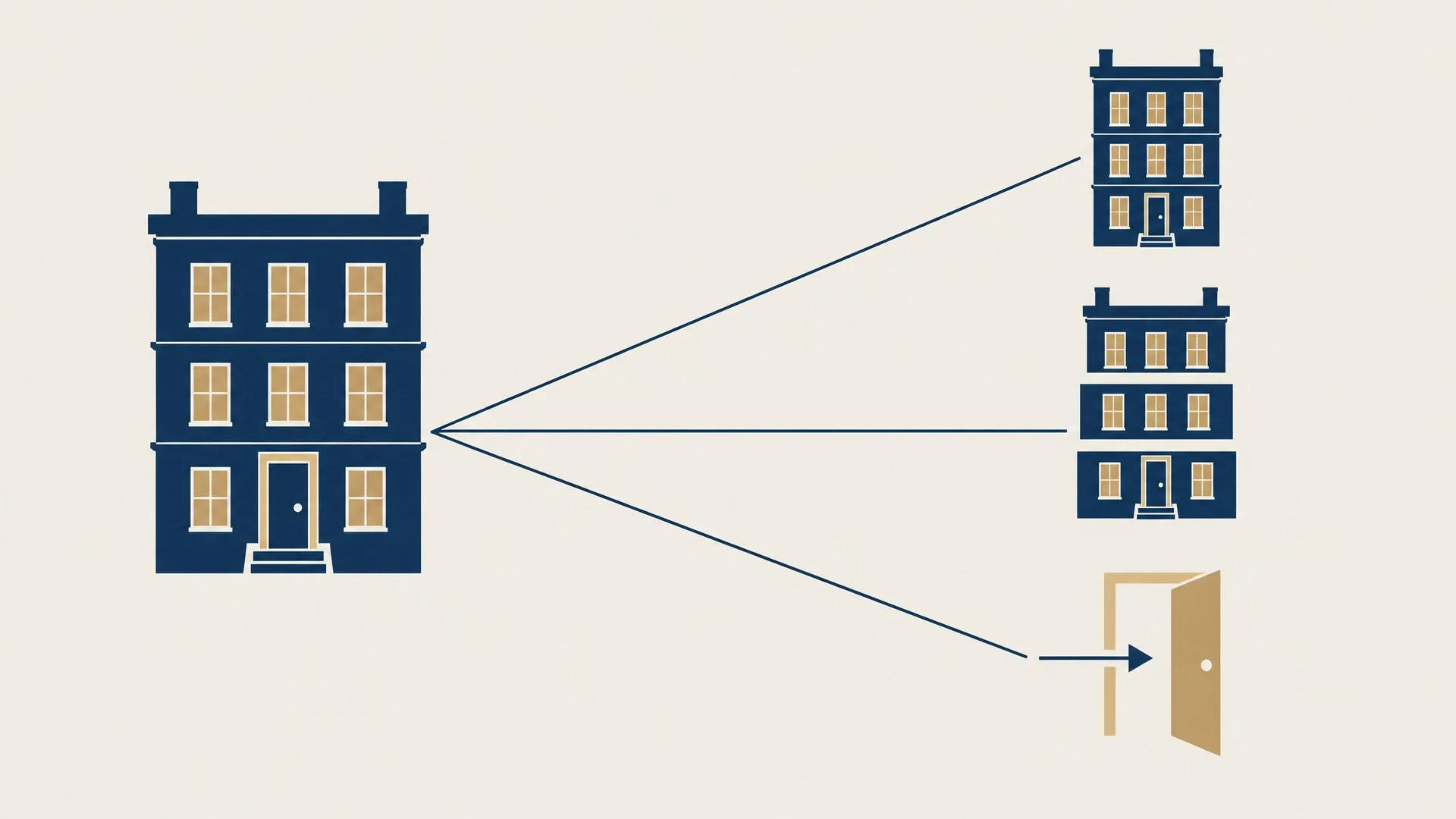

There are three real ways to defer the tax on an apartment building sale. The 1031 exchange is the one owners have heard of. The other two are where the interesting decisions live.
And one of them is a door that does not open again once you walk through it.
A necessary disclosure first. This article is general education, not tax, legal or investment advice. Two of these three options involve securities, not real estate. I am a real estate advisor. I can explain how they work. I cannot recommend one to you, and I am not going to. Work through your own situation with your CPA, your attorney, a qualified intermediary, and a securities-licensed advisor.
Choosing with the clock running
Owners get into trouble by selling first and thinking about deferral second. The moment that sale closes, a 45-day clock starts running.
An owner shopping for replacement property under a 45-day deadline is not a buyer. He is a hostage. He takes whatever is in front of him, from whoever called him first, and he pays for the privilege.
That is passive ownership showing up at the most expensive possible moment. He is choosing under a clock, not on purpose.
Deferral only matters after you have decided that selling is right. If you have not built that comparison yet, start with Sell, Refinance, or Hold? The 3-Column Math That Ends the Debate.
Option 1: the 1031 exchange
You sell, and instead of taking the money, you roll it into another piece of real property. The tax is deferred, not erased.
The rules that matter:
- A qualified intermediary has to be in place before your sale closes.
- You cannot touch the money, not even for a day.
- 45 days from closing to identify replacement property in writing.
- 180 days total to close on it.
Then there is the trap: boot. Any cash you walk away with, or any reduction in your debt that you do not replace, is taxable.
Example: sell a $4 million building carrying a $1.5 million loan. You generally need to buy at $4 million or more, with $1.5 million or more of debt, or you create boot.
An illustrative variation on the same sale. Say the replacement building carries a $1.2 million loan instead. The loan drops from $1,500,000 to $1,200,000, and $1,500,000 minus $1,200,000 is a $300,000 reduction in debt. If you do not replace it, that $300,000 is boot, and it is taxable. What boot costs you in tax depends on your own basis and history, so that number comes from your CPA.
What you keep with a 1031 is control, and the ability to do it again.
Option 2: the Delaware statutory trust
You buy a fractional interest in an institutionally managed property. It qualifies as replacement property for a 1031, which solves two problems at once.
It solves the 45-day deadline, because these are available and ready to close. And it solves the operations problem, because you are done managing anything.
That is appealing to an owner who is tired. It is also why these get sold hard.
What you give up:
- Control, completely. You have no say in operations, refinancing, or sale timing.
- Liquidity, largely. There is no real secondary market.
- Flexibility on problems. The trustee is restricted in what it can do with the property, which means it cannot always react well when something goes wrong.
A DST interest is a security. It is not a deed. You buy it through a broker-dealer, not through me.
Option 3: the 721 UPREIT
This is the one almost nobody explains to small building owners.
You contribute your property into a real estate investment trust’s operating partnership. In exchange, you receive operating partnership units. There is no tax at contribution.
What you get:
- Diversification across a whole portfolio instead of one building.
- An income stream.
- Eventual liquidity, because those units can convert into REIT shares you can sell.
Now the catch. This is a one-way door. Once you hold operating partnership units, you cannot 1031 out again. You are out of real property and into a partnership interest. And when you convert those units into shares, that conversion is a taxable event.
So this is not an exchange strategy. It is an estate and income strategy, and it works best for owners planning around a step-up in basis at death.
How to choose: four questions, not one
- Do you want to keep operating? If yes, a 1031 into real property. Nothing else keeps you operating.
- Do you want out of operations, but want to keep the ability to exchange again later? That is the DST conversation.
- Do you want out permanently, want income and diversification, and are you planning around your estate? That is the UPREIT conversation.
- Are you choosing this, or is somebody selling it to you? This is the real one.
Here is my line. Deferring tax is not the same as avoiding it. One of these three is a door that locks behind you, and owners are rarely told that before they walk through it.
The deferral question also sits inside a bigger one: what you actually keep after you sell, once every tax line comes off.
My role, plainly
I can help you identify and buy replacement real property. That is what a 1031 is, and that is what I do.
I am not securities-licensed. DST interests and operating partnership units are securities. I do not sell them, I do not recommend specific ones, and I do not get paid on them.
If somebody in my position is steering you toward a specific sponsor, ask him how he is compensated. It is a fair question, and you are entitled to a straight answer.
What I can do is make sure you have this conversation early enough to have a choice.
Start before the sale closes
Answer the four questions above on paper before you list, not after you close. If question one is a yes, your 1031 planning starts with lining up the qualified intermediary before closing. If question two or three is a yes, the DST or UPREIT conversation starts with your CPA, your attorney and a securities-licensed advisor, with time on your side rather than 45 days.
Then ask question four about every pitch you hear.
Leaning toward a sale? The Exit Navigator Scorecard puts the readiness questions on one page. Then book a free 15-minute call, bring your CPA if you can, and we will look at where your building sits before any clock starts.
Frequently asked questions
What are the ways to defer tax when I sell an apartment building? There are three real ones. A 1031 exchange rolls the sale into another piece of real property. A Delaware statutory trust is a fractional interest in an institutionally managed property that qualifies as 1031 replacement property. A 721 UPREIT contributes your property into a REIT’s operating partnership in exchange for operating partnership units. All three defer the tax. None of them erase it.
What are the 1031 exchange deadlines? A qualified intermediary has to be in place before your sale closes, and you cannot touch the money, not even for a day. You have 45 days from closing to identify replacement property in writing, and 180 days total to close on it.
What is boot in a 1031 exchange? Boot is any cash you walk away with, or any reduction in your debt that you do not replace, and it is taxable. Sell a $4 million building carrying a $1.5 million loan and you generally need to buy at $4 million or more, with $1.5 million or more of debt, or you create boot.
Can I do a 1031 exchange after a 721 UPREIT? No. Once you hold operating partnership units, you cannot 1031 out again. You are out of real property and into a partnership interest, and converting those units into REIT shares is a taxable event. That is why the UPREIT is an estate and income strategy, not an exchange strategy.