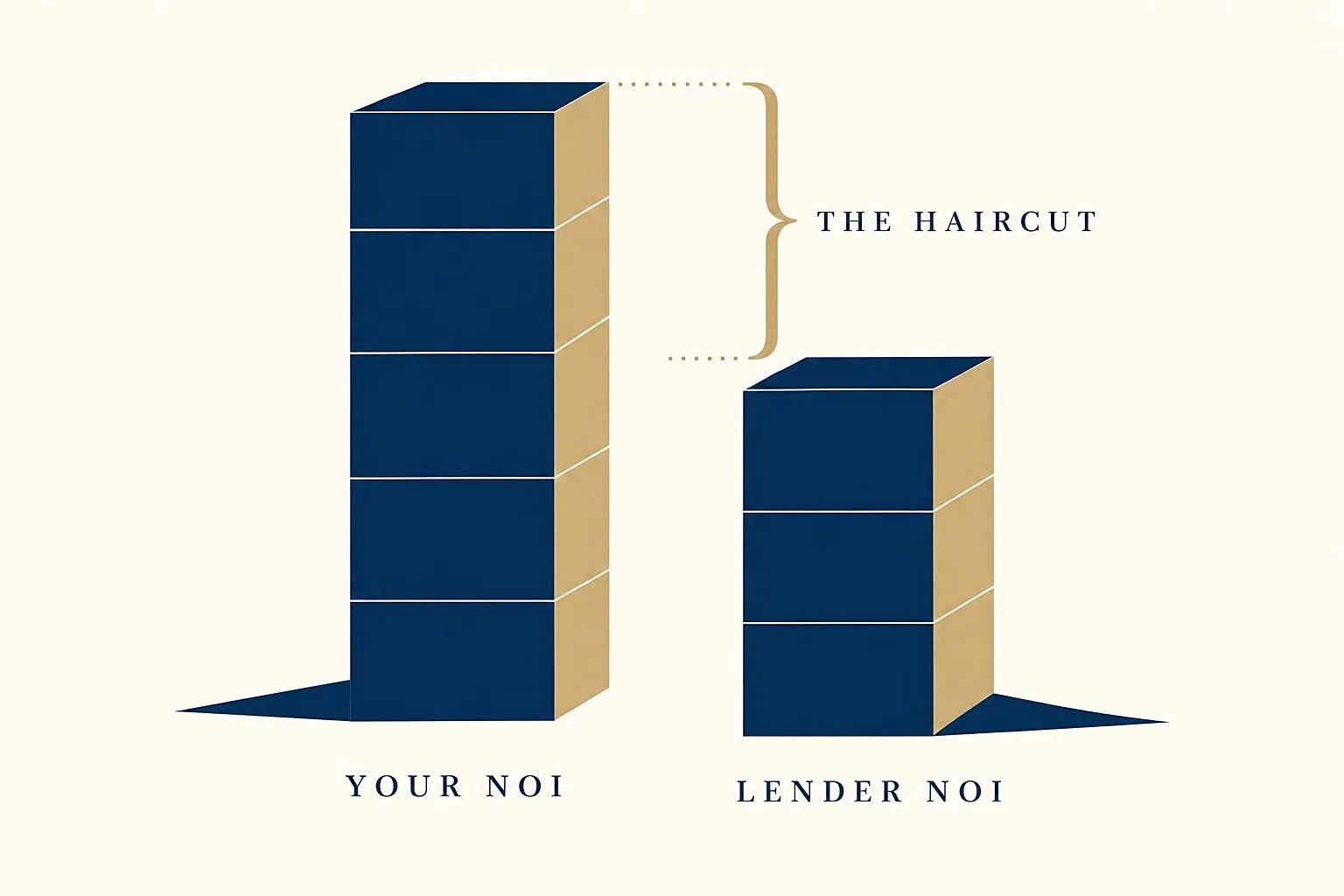

The number in your head is not the number a lender will hand you. On the 12-unit building below the gap runs $880,000, and every dollar of it is arithmetic you can run yourself before a lender runs it for you.
Both versions of the calculation, side by side.
The owner’s math
A 12-unit building with $480,000 in gross rents. Operating expenses of $152,000. Vacancy running at about 3 percent, because the building is full.
$480,000 less 3 percent vacancy is $465,600. Subtract $152,000 of expenses and net operating income is $313,600.
Apply a 6.5 percent cap rate and the building is worth about $4.8 million. The lender goes to 75 percent of that, which is a loan of roughly $3.6 million. You owe $2.4 million. Cash out of about $1.2 million.
That is the math owners run. The arithmetic is correct. The problem is that the lender will never use those numbers.
How the lender rebuilds the same building
The underwriter starts over from gross rent.
You used 3 percent vacancy because that is what the building runs at. They use 5 percent, because they have to underwrite a normal year rather than your best one. $480,000 less 5 percent is $456,000. Expenses of $152,000 leave $304,000.
You carry no management fee because you self-manage. They add one anyway, at 6 percent of gross rents, because the building has to cover that cost under any owner. Six percent of $480,000 is $28,800. That takes the income to $275,200.
Two adjustments, $38,400 of income removed, and nobody has walked through your building yet.
The full sequence an underwriter runs, including normalized expenses and replacement reserves, is in How to Refinance a Small Apartment Building.
The part that actually sets the loan
The lender takes that $275,200 and divides it by 1.25, their debt service coverage requirement. That produces the maximum annual mortgage payment the building can carry: $220,160.
Then they work backward from that payment to a loan size, at the example’s 6.5 percent over a 25-year amortization. A $220,160 annual payment supports a loan of about $2.72 million.
Notice what just happened. The value test would have allowed $3.18 million. The coverage test allows $2.72 million. The lender takes the lower number every single time.
So the loan is $2.72 million. You owe $2.4 million.
Your actual cash out is about $320,000.
The gap, in one line
You were counting on $1.2 million. You are getting $320,000. The arithmetic: $1,200,000 less $320,000 is $880,000.
All of it came from the difference between your income statement and theirs. Not from the roof, not from the tenants, not from anything you can see standing in the parking lot.
Run the multiplier and the same result appears from the other direction. At a 1.25 coverage floor and 25-year amortization, every $1,000 of defensible income is worth roughly $10,000 of borrowing capacity. The $38,400 haircut is $384,000 of loan capacity, and the rest of the gap is the value the owner assumed the appraisal would support.
And you will have this conversation again
One detail gets missed almost every time. That loan amortizes over 25 years, but the term is only five. Some lenders go seven, a few go ten.
Five years into a 25-year amortization, you are back at this exact table before the loan is a fifth paid down. So this is not a one-time event. Over one hold, it is four or five conversations.
That changes what getting it right is worth. Fixing the income statement now improves this refinance and every refinance you do on that building for as long as you own it.
Your cash-out number is set by what the lender says your income is, divided by their coverage requirement. Find that number before they show it to you and you still have time to move it. NOI Leak Check is the fastest place to start.
Own a building in Washington DC, Virginia, or Maryland? Local cap rates change the value side of this calculation, and the coverage side stays the same: Refinancing a DC Apartment Building
Get a read on your building. Request a building audit and I will run both versions of your income statement so you can see the gap before a lender does.
Frequently asked questions
How much cash can I take out of an apartment refinance? Take the lender’s version of your net operating income, divide it by 1.25, convert that annual payment into a loan amount, then subtract your existing balance. On the 12-unit example that produced $320,000 rather than the $1.2 million the owner expected.
Why is the lender’s income number lower than mine? Two standard adjustments. A 5 percent vacancy factor replaces your actual 3 percent, because the file has to survive a normal year. A management fee at 6 percent of gross rents gets added even when you self-manage. Together they removed $38,400.
How often will I go through this? Most small apartment loans amortize over 25 years but carry a five-year term. Some lenders go seven, a few go ten. You return to this table before the loan is a fifth paid down, which makes it four or five conversations over one hold.