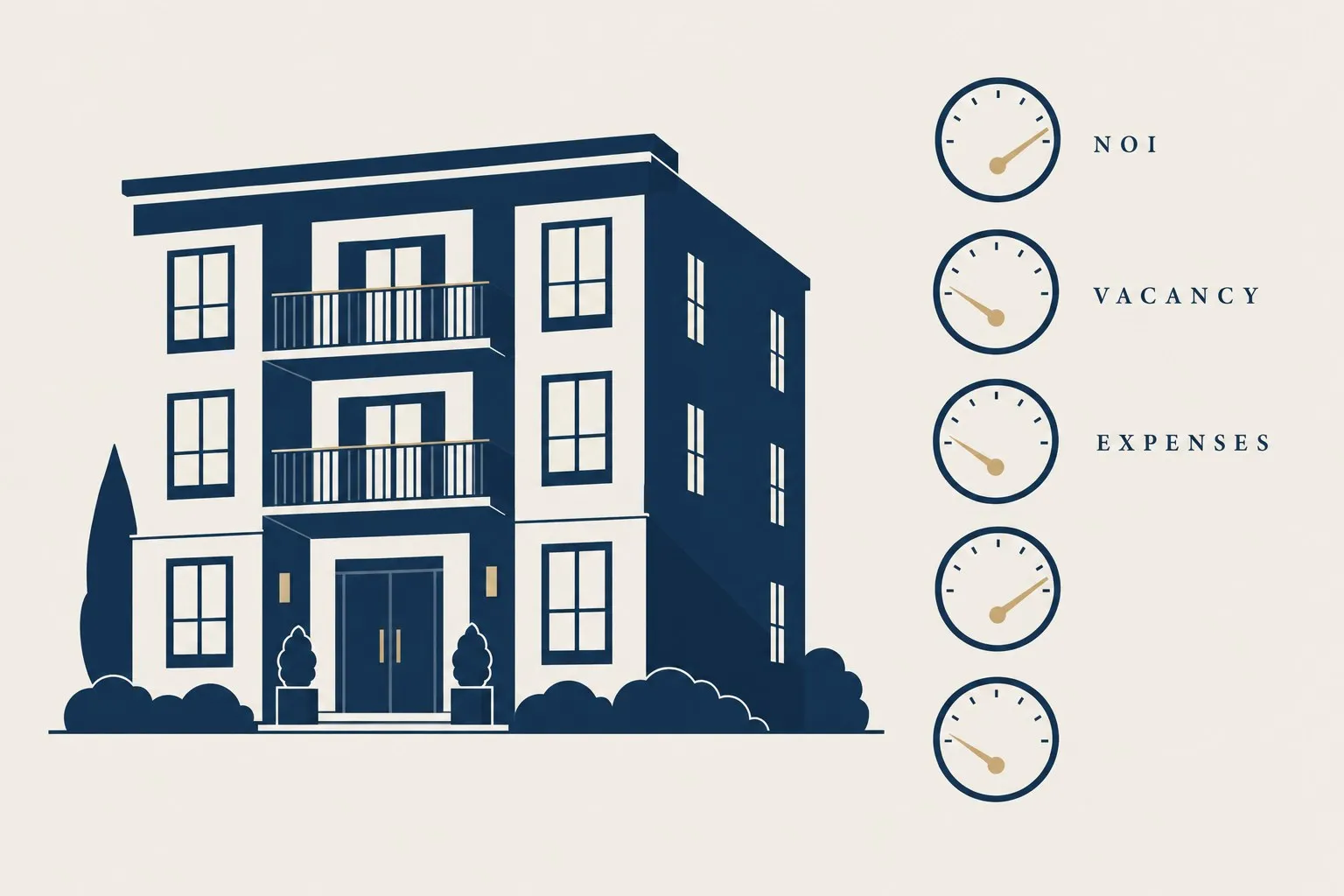

A full building and a well-run building are not the same thing.
Occupancy is the number owners watch, because it is the number they can see from the sidewalk. It tells you the units rent. It tells you nothing about whether you collect every fee, hold expenses flat, or renew at market.
David ran a nine-unit building that was full, with stable rents, and cash flow that shrank every quarter anyway. The rent roll never explained it. The loss sat entirely on the expense side, and it took three years to add up to roughly $24,000 a year. Nothing about the building looked wrong.
Underperformance rarely announces itself. It shows up as a signal you have to know how to read. Here are six, and what each one usually means.
First, why this is a value question
NOI is the scorecard, and value is what NOI capitalizes into.
Every recurring dollar you fail to collect is not a one-time miss. The lender sees the gap when you refinance, and the next buyer capitalizes it when you sell. At a 5 to 7 percent cap rate, $10,000 of missed annual NOI is roughly $140,000 to $200,000 of value you do not have.
So the point of a diagnosis is not tidier books. It is the difference between the number you think your building is worth and the number a lender or a buyer will actually assign it.
Signal 1: The expense ratio has drifted up
Pull your last three years of statements and read the expense ratio, not the top line.
If expenses are eating a larger share of income each year with no capital project behind the rise, something is drifting. Vendor scopes expand. A service you agreed to once renews at a higher rate on its own. None of it is dramatic, which is exactly how it survives. David’s loss accumulated in pieces small enough that no single invoice ever looked wrong.
The signal is a ratio that climbs while nothing visible changes. It usually means the expense side is running without anyone reading it.
Signal 2: Fees on the lease never reach the invoice
Late fees, NSF charges, pet rent, parking, storage, utility reimbursements. This is revenue you are already owed under the lease you already signed.
The gap runs $2,000 to $5,000 a year per building, and it opens on consistency. One month gets skipped during a staffing change. One unit gets missed. Nobody catches it, because no report was built to catch it.
The signal is simple to test. If you cannot confirm that every fee type hits an invoice every month on every unit, you are probably not collecting all of it.
Signal 3: You pay the utility bill and nobody bills it back
Water and sewer are the most common silent NOI killers.
A single undetected leak in a master-metered building can cost $6,000 to $12,000 a year. It shows up as a bill slightly higher than last month, twelve months running. The rule I use: if your water bill spikes more than 15 percent over three consecutive months, that is almost always a leak or a billing error.
The signal is spend you absorb that your leases and local rules would let you recover. It usually means recovery is set up incorrectly, applied inconsistently, or not at all.
Signal 4: Units turn slower than the market
A slow turn costs vacancy days on top of repair dollars, and vacancy days run $100 to $200 each depending on your market.
Compare your average time from move-out to move-in against what comparable buildings nearby are running. If yours is longer, you are paying for the gap in empty units every single turn.
The signal is a turn time you cannot state from memory, or one that beats the local pace by a week or more. It usually means the make-ready scope has no fixed definition of finished.
Signal 5: Maintenance is deferred, not scheduled
Deferred maintenance is a cost you have not paid yet, sitting on the building at interest.
Roofs, systems, and unit conditions that get pushed do not go away. They surface at the worst moment, often during a refinance inspection or a buyer’s due diligence, when you have the least room to negotiate. A building that runs on emergencies rather than a schedule is carrying risk it has not priced.
The signal is a repair list that only moves when something breaks. It usually means condition is working against your next valuation.
Signal 6: No monthly report lands on your desk
This is the signal that hides all the others.
The test is one question. Do you receive a monthly package with a rent roll, a profit and loss statement, variance notes, and a forward action plan? If not, you are managing blind, and every signal above can run for months before you see it.
A missing report is not a criticism of your manager. It is a description of what you are allowed to see. And what you cannot see, you cannot fix.
Run the read on your own building
Six signals, and in any given building two or three are usually carrying the loss. The expensive part is guessing which ones.
Sit down with your last 12 months of statements and walk the six. Any signal you cannot clear from your own records in a few minutes is already a finding. The NOI quick check turns your units, rent, and expenses into a current NOI, flags whether your expense ratio runs high, and shows what each recovered $1,000 is worth. About five minutes.
David’s building did not need more rent. It needed someone to read the bills, and that read was worth $24,000 a year.
Own a building in Washington DC, Virginia, or Maryland? High vacancy and rent stabilization change which signals matter most: How to Increase NOI on a DC Class B Building in a High-Vacancy Market
Work the fix, not just the diagnosis. Once you know the signals, the full method is here: How to Increase NOI on a Small Apartment Building
Get a read on your building. Request a building audit and I will tell you which two or three signals are carrying your loss.
Frequently asked questions
How do I tell if my apartment building is underperforming? Read the operating signals, not the occupancy sign. Check whether your expense ratio has drifted up, whether every lease-permitted fee reaches an invoice, whether you absorb utility costs you could bill back, whether units turn slower than the market, and whether a monthly report lands on your desk. Two or three of those usually carry the loss.
Does a full building mean it is performing well? No. A full building tells you the units rent. It says nothing about whether you are collecting every fee, holding expenses flat, or renewing at market. A building can run at full occupancy and still lose recurring NOI every quarter through billing gaps and cost drift.
What are the clearest signs of an underperforming apartment building? A rising expense ratio with no capital project behind it, lease-permitted fees that never reach an invoice, utility spend absorbed instead of billed back, turn times longer than the market, deferred maintenance stacking up, and no monthly reporting package. Each is a signal with a dollar figure behind it.
Why does underperformance matter for building value? Because NOI capitalizes into value. Every recurring dollar you fail to collect is a dollar the lender and the next buyer both price against you. At a 5 to 7 percent cap rate, $10,000 of missed annual NOI is roughly $140,000 to $200,000 of value you do not have.